Blog
Introducing Begun Evals: the easiest way to evaluate any model
Run frontier agentic evals on any model, including your own. Launch them from your agent. See exactly where each model fails. No infrastructure to build.
Daniel Mankowitz
If you are building with AI, you are already dependent on evals, whether you have built any or not. Every decision about which model to ship, which agent to trust with a workflow, and whether last month's fine-tune actually helped comes down to one question: can you measure it?
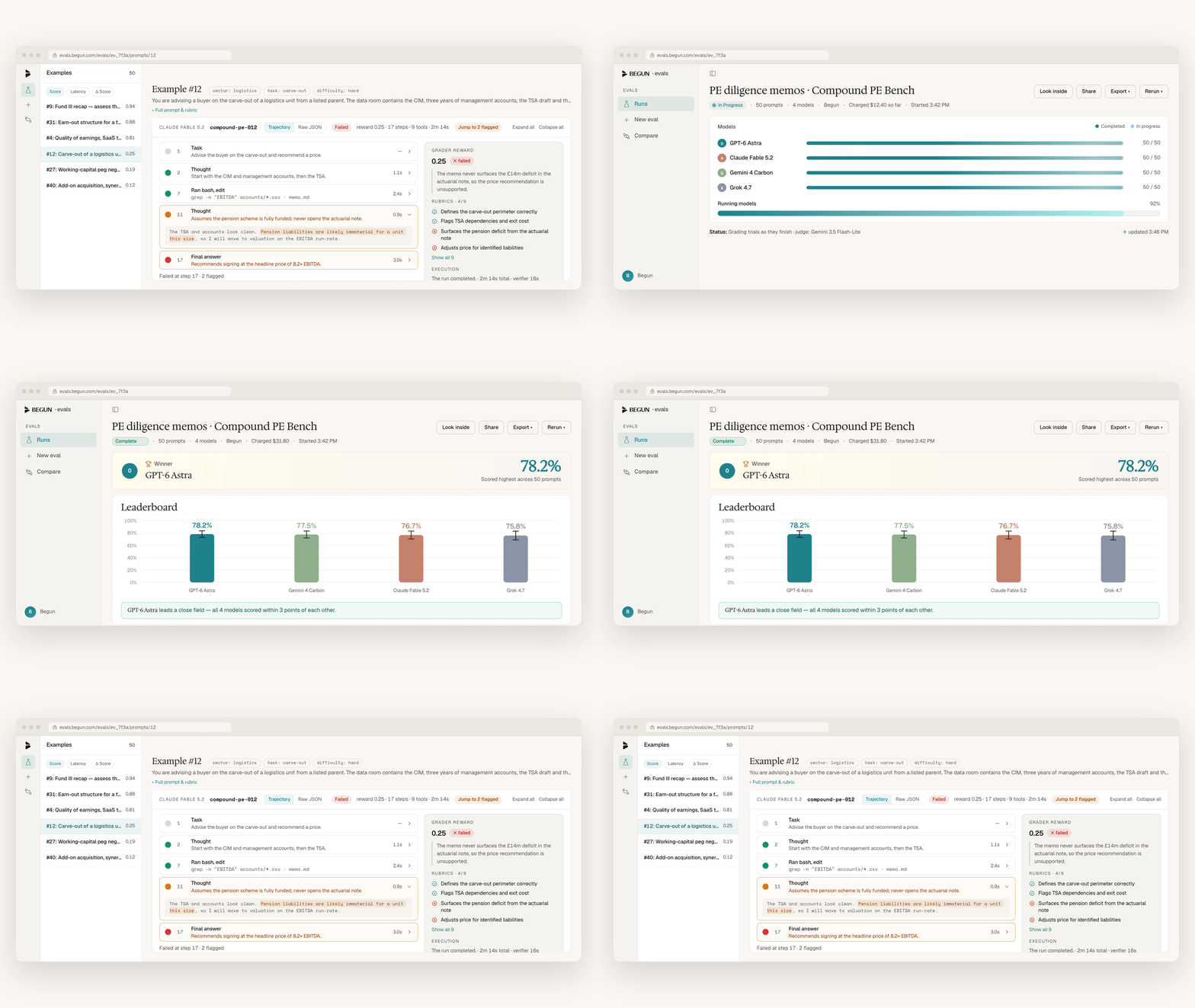
Today we are publicly launching Begun Evals, the platform we built to answer that question for vertical AI companies, startups, enterprises and more.
Begun Evals already powers evaluation programs and generates millions of dollars in revenue. When we opened the private beta, more than 5,000 people and companies applied within the first 48 hours.
Here is why we built it, what it does, and how to get access.
Why everyone needs evals now
In the age of modern AI, enterprises, labs, startups and hobbyists all depend on the same thing: the ability to measure what an agent can actually do. That might be backend automation. It might be mission-critical capability, like forecasting for a trading firm or logistics modeling for a freight forwarder.
An eval is simply a repeatable test of that capability. It is how a company measures progress, compares models, and knows whether AI is ready for a given job.
There are two kinds of evals, and you may need both. Public evals, like SWE-bench Pro, measure general capabilities and tell you where a model stands against the field. Private evals, built on your own data and workflows, tell you how a model does on the tasks that matter to you and your company.
Why evals are so hard to build
Evals are notoriously hard to build, and agentic evals are the hardest of all.
Take computer use. To run one properly you need an Ubuntu desktop in a sandboxed virtual machine, spun up at scale on cloud infrastructure, with an agent driving the mouse and keyboard inside it, a grader checking the outcome, and all of it torn down safely afterwards. That is a real engineering project before you have measured a single thing.
Now multiply it. A serious evaluation program is not one benchmark but tens, or hundreds, each with its own environment image, agent harness and grading rules, and each drifting as the underlying benchmark updates. A single agentic eval now takes hours, so you have to run many in parallel to get an answer in a reasonable amount of time. And every one of them is an agent with tool access that has to be sandboxed and watched: the recent security incidents around evals show what happens when it is not. For most enterprises that is either too expensive to staff, too insecure or too slow to deliver.
What we built
Our team spent years building evals inside Google DeepMind, AWS and McKinsey, and that experience is what this platform is built on. Begun Evals implements the majority of the agentic evals that are publicly available. As of today the catalogue holds hundreds of end-to-end benchmarks, from SWE-bench Pro to OSWorld to Terminal-Bench, and it is updated constantly. If a benchmark you need is missing, you can request it.
Here is what the platform does.
1. High quality, custom, private enterprise evals
A custom, private eval turns your company work flows and tasks into a measured benchmark: the tickets, documents, spreadsheets, emails and systems your team actually touches, rebuilt as tasks with a definite answer and an automatic grader. Not "write a forecasting memo" but "here is six months of our order data and the market feed, produce the Q3 forecast the way our department does it", scored against what good looks like at your company.
How we build one. We start with the work your team already does: the documents, tickets and spreadsheets from real cases, not a list of questions about them. From those we pick out the tasks that matter most and are genuinely hard, and turn each one into a test with a clear right answer that can be marked automatically. Then we check that the test actually tells models apart, so you see real differences rather than everyone getting the same score. With your data in hand, the first eval is up and running in a matter of days, not quarters.
What you get. Your own private eval, held inside your organization's account. Run any model against it, including one your company created, as often as you like, and see exactly where each one went wrong on your tasks.
2. Run the frontier benchmarks, on any model, in one click
The benchmarks in every frontier model card are ready to run on any model you choose: agentic coding, terminal work, computer use, tool use, hard reasoning and more. Compare your model on the benchmarks that matter.
| Benchmark | What it measures |
|---|---|
| SWE-bench Verified | Agentic coding on real GitHub issues |
| SWE-Bench Pro | Harder, longer-horizon agentic coding |
| Terminal-Bench 2.1 | Terminal and systems work |
| OSWorld | Computer use on a real desktop |
| tau-bench | Tool use in customer-facing workflows |
| Humanity's Last Exam | Hard expert-level reasoning |
| And many more! |
3. Run evals directly from your agent
This is one of the features we are really excited about. Add our MCP server to Claude Code, Cursor or Codex and ask in plain English:
"Run SWE-bench Verified on these three models and tell me where they differ."
Your agent searches the catalogue, shows you the estimated cost, launches the run and reads the results back to you. No dashboard required.
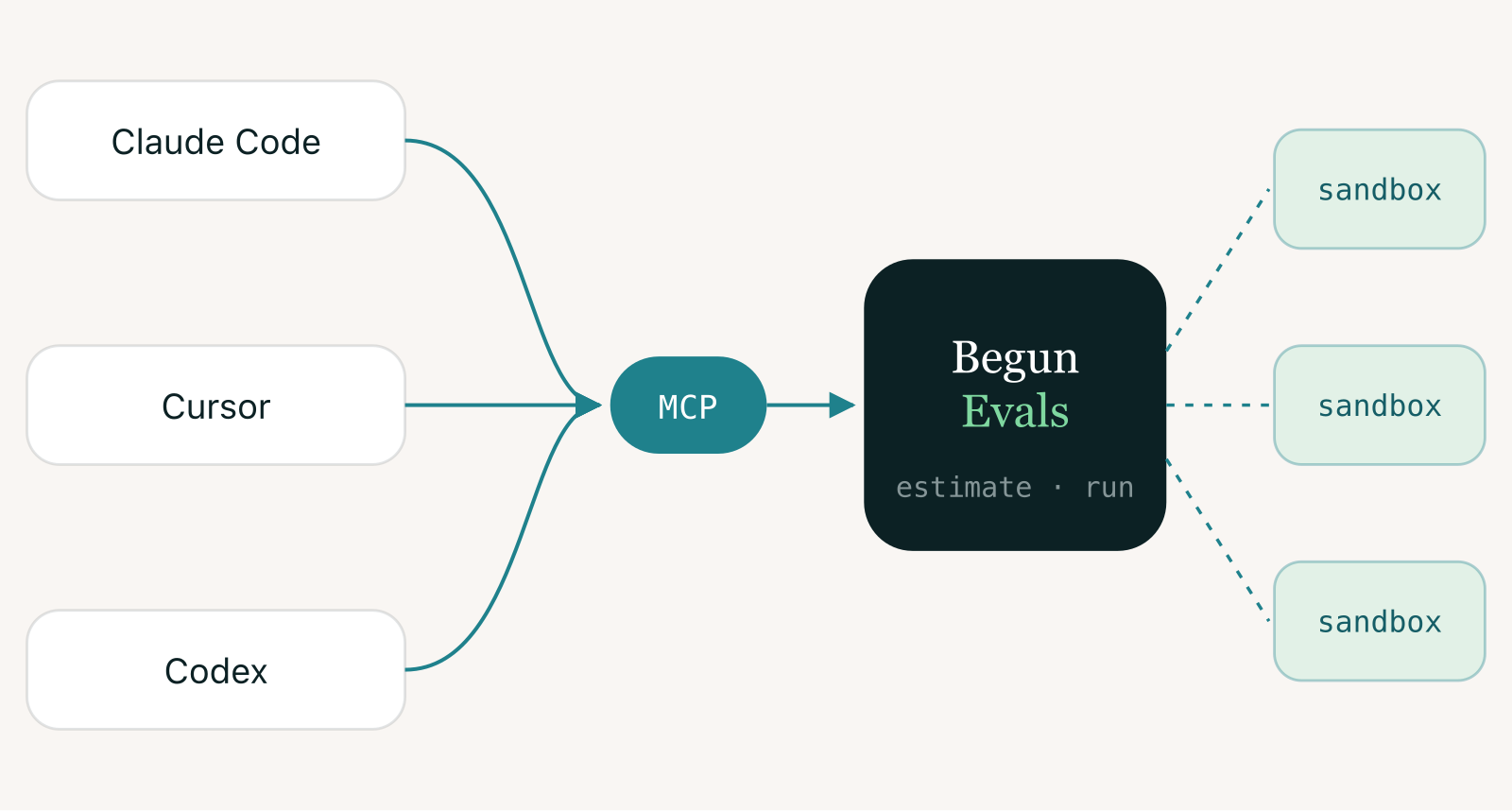
Setup is one line:
claude mcp add --transport http begun-evals https://evals.begun.com/mcp/
4. Evaluate your own model, side by side with the frontier
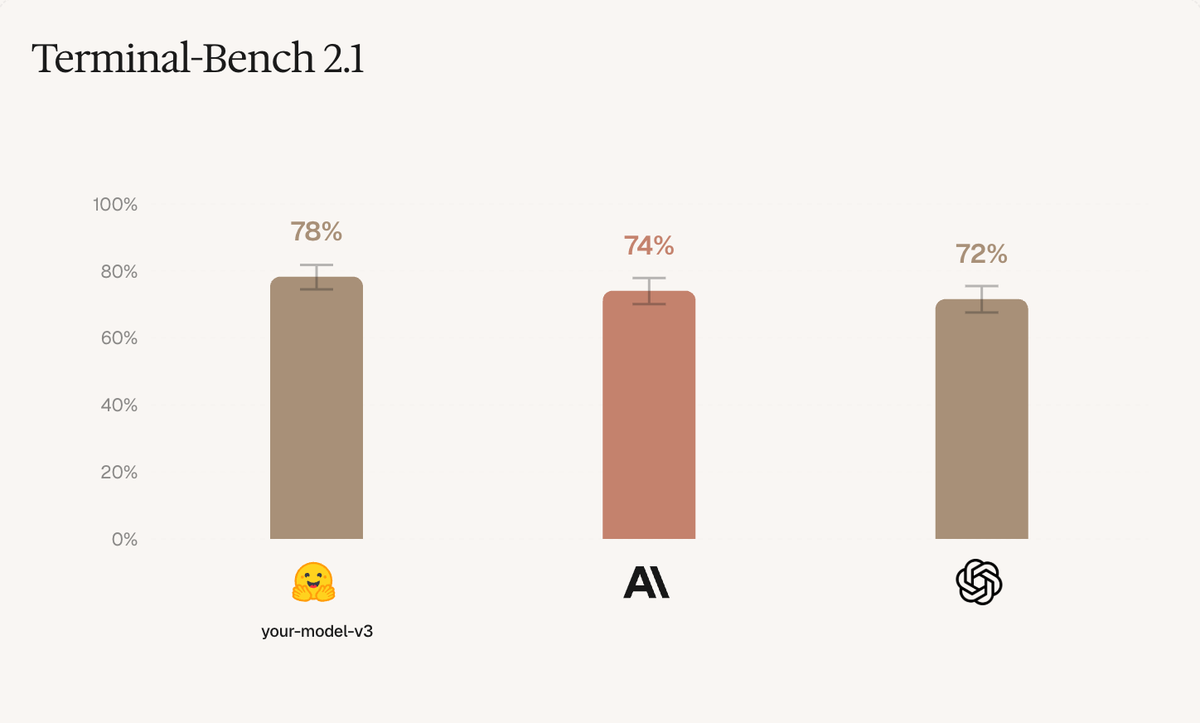
Point us at any OpenAI-compatible endpoint: vLLM, TGI, a cloud deployment, a private gateway. We check the connection once, then score your model on exactly the same benchmarks as the frontier models.
5. Run agentic benchmarks safely
We work with some fantastic providers for sandboxing, specifically Daytona and Modal. The sandboxes, environment images, harnesses and graders are ours to run. What you should care about is what happens inside them.
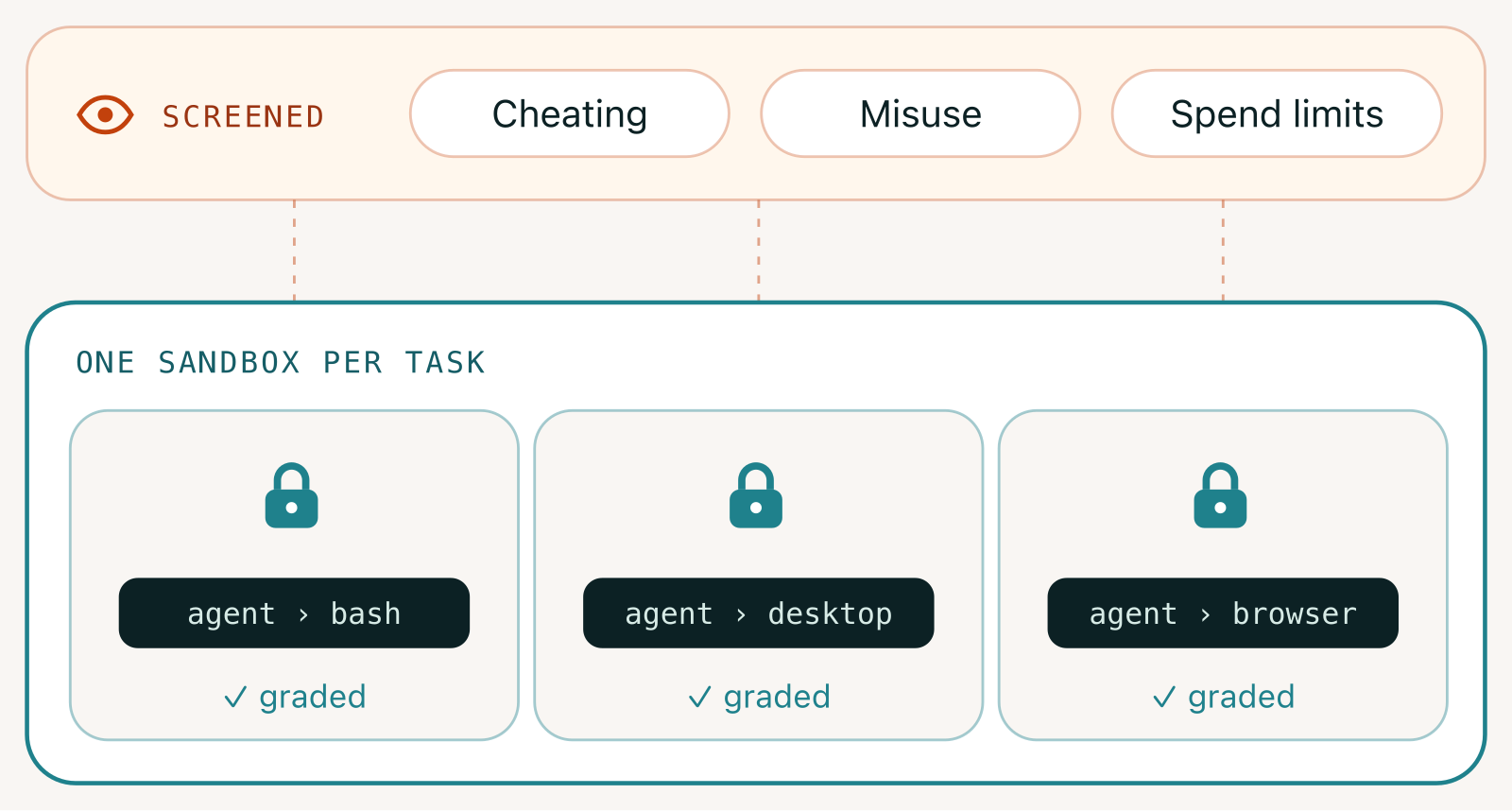
We also keep each agent contained. Every task gets its own isolated sandbox, and every finished trajectory is screened for cheating, that includes reward hacking, like looking up the answer or tampering with the grader, and for misuse, like trying to escape the sandbox or reach credentials.
Run limits stop runaway spend. You set a maximum per eval and it stops the moment it gets there.
6. See exactly where it fails
A score tells you who lost. It does not tell you why. The fastest way to improve a model is to see exactly where it fails, so we built the trial reader to show you every step each agent took, with the steps that errored flagged so you can jump straight to them.
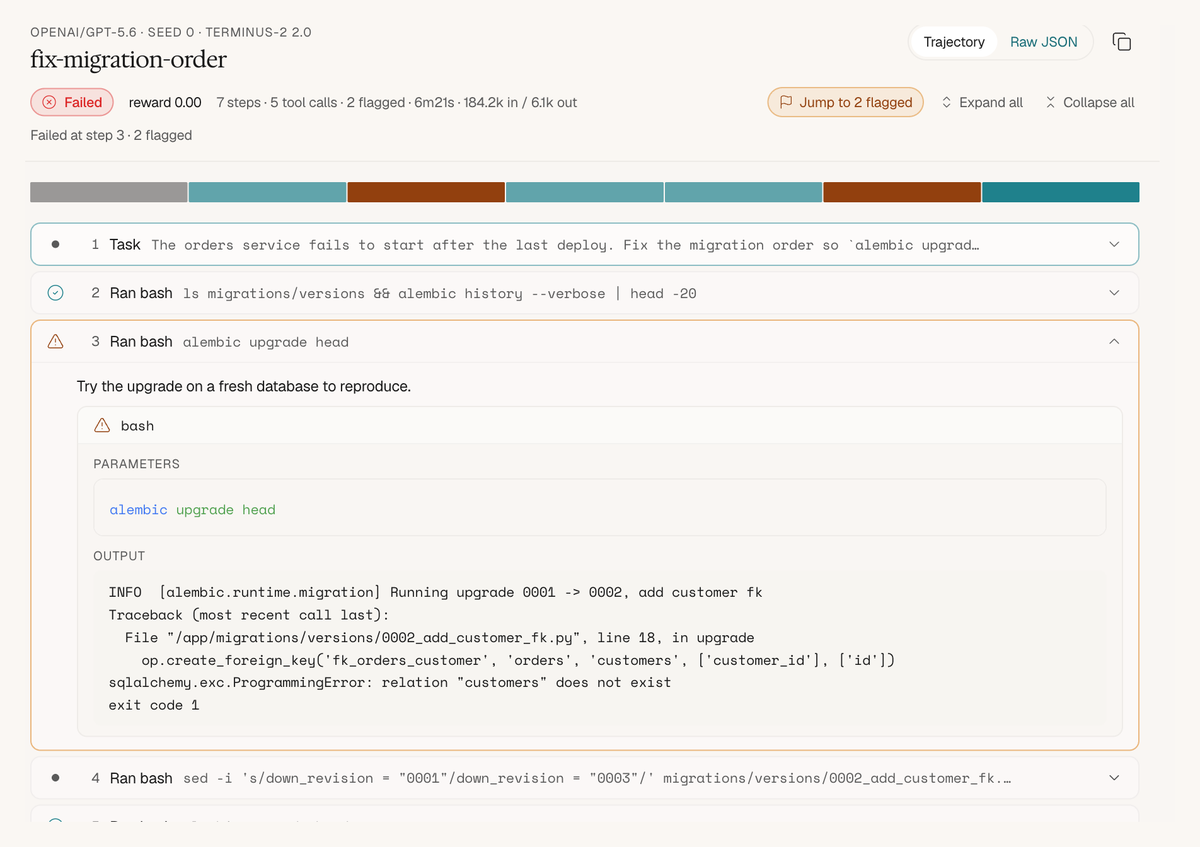
- Read every trajectory, with screenshots for computer-use runs.
- Compare models on the same task, side by side.
- Share a no-login link with a colleague, or download every trajectory.
What this looks like in practice
A startup shipping an agent. You are three weeks from launch and a new model just dropped. Instead of a debate in Slack, you ask Claude Code to run your private eval and SWE-bench Verified on both models, read the cost estimate, and have an answer by lunch. The step-by-step logs tell you the new model is faster but fails on the two task types your customers care about. You stay put, and you know why.
An enterprise AI team. You have to pick a vendor for a forecasting workflow and justify it to procurement. You build a private eval from six months of real cases, run every candidate on it, each in its own sandbox, and hand over a report with scores, cost per task and the exact steps where each model went wrong. The decision survives the review because it is measured, not argued.
A vertical AI company with its own model. You have trained a model for your domain and need to prove it beats the frontier for your customers. You connect it to Begun Evals, run it side by side with the frontier models on the same benchmarks, and publish the chart. Your model never leaves your own servers.
Pricing
No subscription and no seats. You pay for what each eval uses, and you see an estimate before it runs:
- $0 platform fee. No minimum.
- 30% on top of model token cost, for the model under test and LLM grading, dropping to 25% once you spend more than $10K. Bring your own OpenRouter key and the provider bills you directly for the model.
- Sandbox compute for agentic benchmarks, charged per task for what it uses.
Set a max spend per eval and it stops when it gets there. Full pricing here.
Get started today
Begun Evals is open to everyone today. Get started in minutes. Running at lab scale? Talk to us.
About the author
Daniel Mankowitz is the CTO of Begun (previously known as Ethos). Before Begun he was a Staff Research Scientist at Google DeepMind, an early contributor to Gemini, and an author of work published in Nature and Science. He has spent his career building evals and RL environments for real-world systems, from data centres to Google products and enterprises.
- Daniel Mankowitz, CTO, Begun